Chimney Safety & Maintenance in New Jersey: When to Inspect and Clean Your Chimney
There is nothing quite like having a fire going on a cold New Jersey evening. But before you stack the firewood, open the damper, and settle in, it is important to know what condition your chimney is actually in. A Level 2 chimney inspection in New Jersey can identify problems inside the chimney and flue that simply cannot be seen by looking up from the fireplace or standing outside at ground level.
At Dynamic Inspections LLC, we look at chimneys as part of the home as a whole. The fireplace may be what you see in the living room, but the complete system can include a firebox, smoke chamber, flue liner, masonry, crown, cap, flashing, appliance connections, and portions of the chimney that are completely hidden from normal view.
Whether your chimney serves a wood-burning fireplace, wood stove, oil-fired boiler, gas furnace, water heater, or another fuel-burning appliance, understanding its condition is an important part of owning, maintaining, or purchasing a home.
Chimney Inspection & Cleaning: The Quick Answer
- Have fireplaces, chimneys, and venting systems inspected at least annually.
- Wood-burning chimneys should be cleaned based on soot and creosote accumulation rather than an arbitrary calendar date.
- If you burn approximately a cord or more of firewood during a season, do not skip the annual inspection.
- Oil-fired appliance chimneys should be evaluated as part of regular heating-system maintenance and cleaned when soot or deposits warrant removal.
- Gas-fired appliance chimneys may not require regular sweeping, but they still need inspection for deterioration, blockage, corrosion, moisture, and venting problems.
- A home purchase is one of the situations where a more detailed Level 2 chimney inspection may be appropriate.
Why Chimney Safety and Maintenance Matter
A New Jersey chimney has a tough job.
The inside may be exposed to heat, smoke, soot, combustion gases, moisture, and acidic combustion byproducts. Meanwhile, the exterior spends decades dealing with rain, snow, summer heat, wind, and repeated winter freeze-thaw cycles.
Over time, things change.
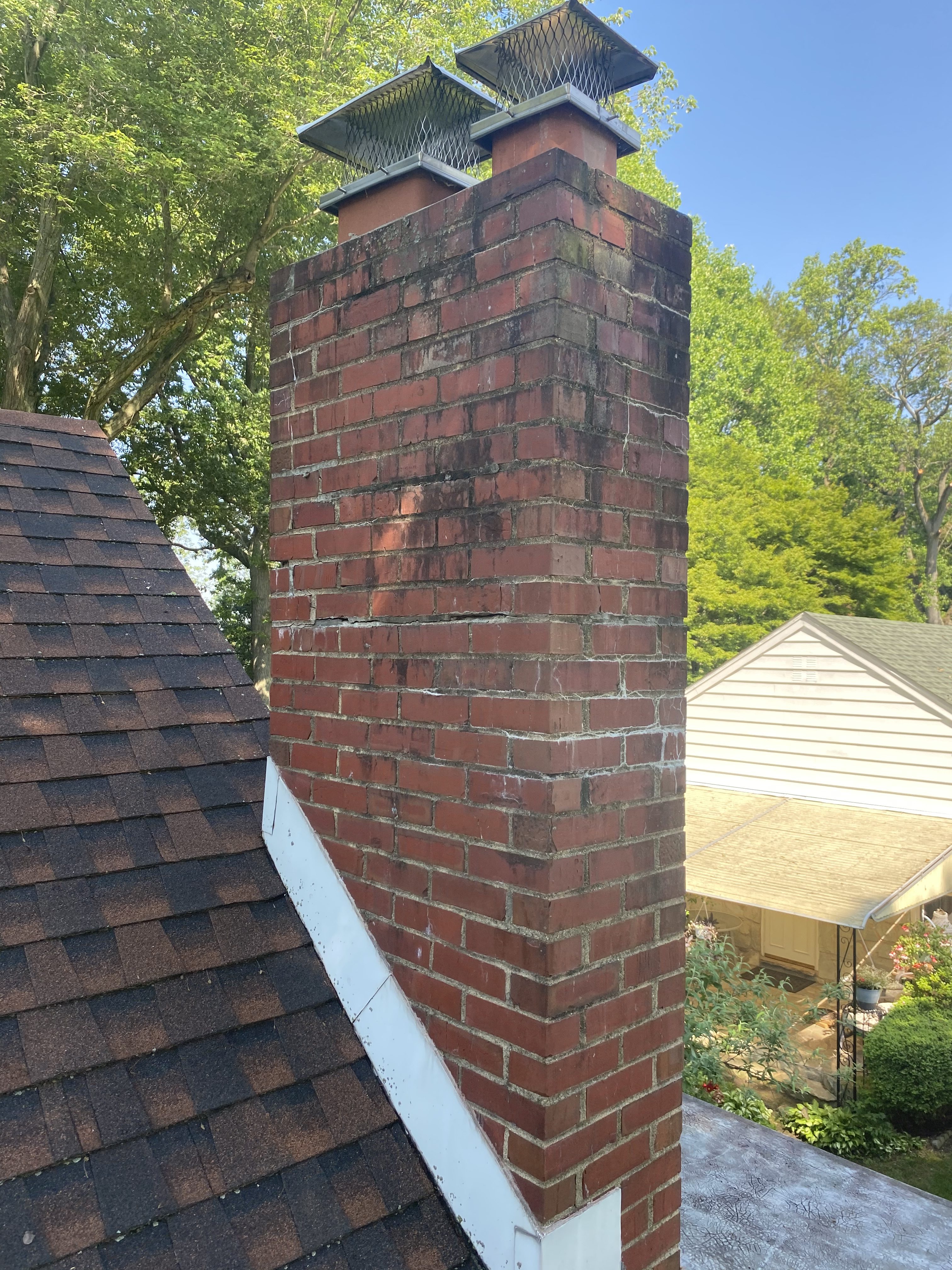
Mortar deteriorates. Brick can crack or spall. Water finds its way into small openings. Metal vent connectors corrode. Chimney crowns develop cracks. Animals build nests. Flue liners can become damaged. Previous repairs can fail.
Many of these conditions are not obvious from the living room.
A chimney does not have to be actively leaking, smoking, or causing an odor before it deserves attention. Many chimney defects develop slowly and remain largely hidden until someone takes a closer look.
How Often Should a Chimney Be Inspected?
Chimneys, fireplaces, and venting systems should generally be inspected at least annually.
The Chimney Safety Institute of America provides homeowner guidance regarding chimney inspection, cleaning, maintenance, and proper venting.
Annual inspection is important even when you use the fireplace only occasionally. A chimney can deteriorate while sitting unused because exterior weather exposure, moisture, animal activity, and aging continue regardless of how many fires you burn.
Inspection is particularly important when:
- You recently purchased the home.
- You do not know the chimney's maintenance history.
- The fireplace has not been used for several years.
- A chimney fire is known or suspected to have occurred.
- The heating appliance or fuel type has been changed.
- The chimney has been relined, altered, or repaired.
- You see masonry deterioration, water staining, debris, rust, or other warning signs.
How Often Should You Have Your Chimney Cleaned?
This is one of the most common questions homeowners ask us.
The important thing to understand is that inspection and cleaning are not the same service.
Inspection evaluates the condition of the system. Cleaning removes soot, creosote, deposits, or debris when necessary.
The appropriate cleaning schedule depends heavily on what the chimney serves.
| Chimney / Appliance Type | Inspection | Cleaning |
|---|---|---|
| Wood-Burning Fireplace | At least annually | Based on soot and creosote accumulation |
| Wood Stove | At least annually | Based on use, deposits, and condition |
| Oil Furnace or Boiler | Typically evaluated with annual heating-system maintenance | When soot or deposits warrant removal |
| Gas Furnace, Boiler, or Water Heater | Regular inspection of the chimney and venting system | When debris, deterioration products, or obstruction warrant cleaning |
Wood-Burning Fireplaces and Wood Stoves
Wood-burning systems can accumulate soot and creosote inside the chimney. How quickly that happens varies greatly from one home to another.
The amount of wood burned is useful information, but there is no universal rule stating that every chimney must automatically be cleaned after exactly one cord or one-and-a-half cords of wood.
A homeowner burning properly seasoned wood in an efficient system may experience very different buildup than someone burning wet wood, operating low-temperature fires, or dealing with poor chimney draft.
As a practical homeowner guideline, if you have burned approximately one to one-and-a-half cords of firewood, it is a good time to think about the chimney's condition. If you use the fireplace heavily throughout the winter, that point may arrive before the heating season ends.
What Is Creosote?
Creosote is a combustible deposit that forms as byproducts from wood combustion cool and condense inside the chimney.
It can range from relatively loose, flaky deposits to hard, shiny, glazed material.
Creosote matters because combustible deposits inside a chimney can contribute to chimney fires.
Burning wet or poorly seasoned wood, operating low-temperature fires, restricting airflow, poor draft, and other burning conditions can increase accumulation.
A fireplace that looks clean from the room does not tell you how much soot or creosote may be present farther up the flue.
Oil Furnace and Oil Boiler Chimneys
Oil-fired appliances create different combustion byproducts than wood-burning fireplaces, but their chimneys still require attention.
Soot can accumulate inside the appliance connector and chimney. Oil combustion byproducts can also be corrosive, particularly when moisture is present.
Oil-fired heating equipment is generally serviced regularly, and the venting system should be part of that conversation.
The chimney should be inspected and cleaned when soot or other deposits indicate that cleaning is needed.
If an oil appliance is producing excessive soot, cleaning the chimney alone may not solve the problem. The burner, combustion process, draft, or appliance condition may also need evaluation by a qualified heating professional.
Gas Furnace, Boiler and Water Heater Chimneys
Gas-fired equipment often causes confusion because homeowners hear that natural gas or propane burns cleaner than wood or oil.
That is true in terms of soot and creosote, but it does not make the chimney maintenance-free.
Older masonry chimneys serving gas-fired equipment can develop problems involving moisture, acidic condensate, deterioration of clay flue components, debris, corrosion, improper appliance connections, or obstructions.
This can become especially important when newer heating equipment has been connected to an older chimney originally designed around very different appliances.

Cleaning and Inspection Are Not the Same Thing
A gas chimney may have very little material that needs to be physically swept out and still have an important defect.
A damaged liner, deteriorated masonry, improper vent connection, corrosion, moisture condition, or obstruction can exist even in a relatively clean chimney.
That is why a clean chimney is not automatically a safe chimney.
Why Looking Up the Fireplace Isn't Enough
Homeowners sometimes tell us, “I looked up the chimney with a flashlight and it looked fine.”
That is understandable. The problem is visibility.
You may be able to see the firebox, damper, and a portion of the smoke chamber or lower flue. But the chimney may continue another 20, 30, or more feet through the home and above the roof.
Offsets and changes in direction can make direct visual inspection even more difficult.
A defect that exists well above the fireplace opening may be impossible to see without appropriate inspection equipment.

What Is a Level 2 Chimney Inspection?
A Level 2 inspection goes beyond a basic examination of readily accessible chimney components.
A Level 2 chimney inspection in New Jersey is commonly associated with real estate transactions, changes to appliances or fuel type, chimney relining, certain system modifications, or circumstances where a more detailed evaluation is warranted.
One of the most useful parts of a Level 2 inspection is internal video scanning of the flue.
A camera allows the inspector to evaluate areas that cannot be adequately viewed from the fireplace opening or chimney termination.
Depending on the system and accessibility, internal scanning may reveal:
- Cracked flue tiles
- Deteriorated mortar joints
- Open gaps between liner sections
- Displaced or damaged components
- Debris and obstructions
- Evidence of previous repairs
- Deposits or buildup
- Other conditions requiring further evaluation or repair
Learn more about our Level 2 chimney inspection services in New Jersey.
Buying a Home With a Fireplace?
A beautiful fireplace tells you very little about the condition of the flue hidden behind it.
A Level 2 chimney inspection can provide additional information before you take ownership of the property.
Common Chimney Problems We Find in New Jersey Homes
New Jersey has an enormous variety of housing.
Throughout Bordentown, Hamilton, Princeton, Burlington County, Mercer County, and surrounding areas, we inspect everything from historic masonry homes to mid-century construction and newer properties.
Age alone does not determine whether a chimney is in good condition.
We have seen older chimneys that were carefully maintained and much newer systems with significant defects. What matters is how the chimney was constructed, how it has been used, what repairs were made, and how well it has been maintained over time.
Deteriorated Mortar and Masonry
Mortar joints naturally weather over time. Once those joints begin to deteriorate, moisture can enter deeper into the masonry assembly.
Repeated wetting and freeze-thaw cycles can accelerate that deterioration.
Loose brick, open joints, cracking, displacement, spalling, and heavy previous patching should be evaluated rather than dismissed as purely cosmetic.

Damaged Chimney Crowns
The chimney crown is located at the top of many masonry chimneys and helps direct water away from the masonry below.
Cracks, deterioration, poor construction, or failed previous repairs can allow moisture to enter the chimney assembly.
A deteriorated crown should not be treated as a purely cosmetic issue because the openings can contribute to continued moisture intrusion and masonry damage.
Flashing and Previous Repairs
The point where a chimney passes through the roof is particularly vulnerable to water intrusion.
Proper flashing is intended to direct water away from the chimney-to-roof intersection.
Heavy applications of roofing cement, caulk, or sealant can sometimes indicate that previous attempts were made to control leakage without correcting the underlying flashing or masonry issue.
Damaged or Deteriorated Flue Liners
Clay tile liners are common in older New Jersey masonry chimneys.
They can crack, deteriorate, become displaced, or develop openings at joints over time.
Many of these conditions are difficult or impossible to evaluate adequately from the fireplace opening alone, which is one reason internal video scanning is so useful.
Water Is One of a Masonry Chimney's Biggest Enemies
When people think about chimney problems, fire usually comes to mind first.
In New Jersey, water deserves just as much attention.
Brick and mortar can absorb moisture. When temperatures fall below freezing, moisture within porous masonry can freeze and expand.
Repeated cycles of wetting, freezing, thawing, and drying can contribute to:
- Spalling brick
- Cracked masonry
- Deteriorated mortar joints
- Damage to chimney crowns
- Corrosion of metal components
- Interior water staining
- Continued deterioration around the roof and chimney intersection

Signs such as white staining, efflorescence, loose mortar, rust, spalling, or interior water stains should not simply be covered over.
The source of the moisture should be investigated.
Chimney Caps and Chimney Crowns Do Different Jobs
Homeowners often use the words cap and crown interchangeably, but they refer to different components.
The Chimney Crown
The crown is generally the masonry or concrete surface at the top of the chimney. Its purpose includes directing water away from the masonry structure below.
The Chimney Cap
The cap is generally installed above the flue opening. It can help reduce entry of rain, leaves, animals, and debris while still allowing smoke and combustion gases to exit.
Both components can play important roles in protecting the chimney system.
Warning Signs Your Chimney Needs Attention
You do not have to wait until smoke enters the room to have a chimney problem.
Some warning signs worth paying attention to include:
- Water staining near the chimney
- Loose or spalling brick
- Cracked masonry
- Deteriorated mortar joints
- White staining or efflorescence
- Pieces of masonry on the roof or ground
- Rust on venting components
- Unusual fireplace odors
- Poor draft
- Smoke entering the home
- Visible soot or creosote
- Debris in the fireplace
- Bird or animal activity
- Damaged chimney caps
- Cracked chimney crowns
- Heavy sealant or patch repairs
Many chimney problems develop gradually. Catching them earlier can give you more options and allow you to plan for maintenance or repairs instead of reacting after a larger problem develops.
Buying a Home With a Fireplace? Don't Assume the Chimney Is Fine
A fireplace is a great selling feature.
During a showing, it is easy to picture a fire going on a cold night and assume that everything above the firebox is ready to use.
But appearance tells you very little about the hidden portions of the chimney.
A freshly painted fireplace can still be connected to a damaged flue. A clean firebox does not tell you whether the liner is cracked. An older masonry chimney may have been modified multiple times as heating equipment changed over the decades.
A Level 2 chimney inspection in New Jersey can provide additional information before closing when a fireplace or chimney is present and the internal condition is unknown.
The purpose is not to tell you whether to purchase the home.
The purpose is to give you clarity about what you are buying.

That information can help you determine whether you are dealing with normal maintenance, a repair that should be budgeted for, or a system that should not be used until additional work is completed.
For a more detailed look at the service itself, visit our Level 2 chimney inspection page.
What About a Fireplace That Hasn't Been Used in Years?
A chimney does not preserve itself simply because nobody uses it.
An unused chimney can still develop problems from water intrusion, masonry deterioration, animal activity, damaged caps, debris, corrosion, and aging.
If a seller tells you, “We haven't used the fireplace in years,” do not treat that as proof that the chimney is in good condition.
Treat it as a reason to understand the system before you use it.
Don't Forget Carbon Monoxide Safety
Fuel-burning appliances can produce carbon monoxide when combustion or venting is improper.
Homes containing fireplaces, wood stoves, boilers, furnaces, water heaters, and other fuel-burning appliances should have properly located and functioning carbon monoxide alarms.
A carbon monoxide alarm is an important safety device, but it does not replace inspection and maintenance of the appliance and its venting system.
The U.S. Consumer Product Safety Commission provides additional information about carbon monoxide and fuel-burning appliance safety.
Chimney Maintenance Is Part of Protecting the Whole House
A chimney passes through multiple parts of a building.
Problems involving the chimney can therefore affect much more than the fireplace.
Water intrusion can damage roof sheathing, framing, insulation, ceilings, walls, and interior finishes.
Deteriorating exterior masonry can become a maintenance or safety concern.
Improper venting can affect the way combustion gases leave the home.
A chimney fire can damage components that are completely concealed from view.
Good chimney maintenance is not about making an older chimney look perfect.
It is about understanding its actual condition and dealing with problems appropriately.
Chimney Inspections in Central and South Jersey
Dynamic Inspections LLC is based in the Bordentown area and provides chimney and property inspection services throughout a broad portion of New Jersey and nearby Eastern Pennsylvania.
Our normal service area includes communities throughout Burlington County and Mercer County and extends into portions of Monmouth, Middlesex, Ocean, Somerset, Hunterdon, Camden, Gloucester, Bucks County, and surrounding areas generally within approximately 90 minutes of Bordentown.
Communities we commonly serve include Bordentown, Hamilton, Robbinsville, Princeton, Lawrence Township, West Windsor, East Windsor, Hopewell, Pennington, Burlington, Mount Laurel, Moorestown, Medford, Marlton, Mount Holly, Chesterfield, Columbus, Florence, Allentown, Freehold, Jackson, Hightstown, and surrounding areas.
You can also visit our Areas We Serve page to learn more about our coverage.
Why Have Dynamic Inspections Evaluate Your Chimney?

At Dynamic Inspections LLC, our job is to inspect.
We are not there to convince you that every chimney needs a major repair.
We evaluate the conditions we can observe, document what we find, and explain why those findings matter.
We also look at how the chimney relates to the rest of the building—the roofing, flashing, masonry, moisture conditions, fireplace, heating equipment, and other accessible components.
That broader approach can be especially useful in older New Jersey homes where chimneys may have been repaired, modified, abandoned, relined, or repurposed multiple times over the life of the property.
Our approach is simple: Inspect. Inform. Educate.
You can learn more about our broader property inspection services.
When Should You Schedule an Inspection?
You do not need to wait until winter or until you smell smoke in the house.
Consider scheduling an inspection before the heating season, before using a fireplace that has been dormant, when purchasing a home, after a chimney fire, after major repairs or appliance changes, when you notice masonry or moisture problems, or when you simply do not know the maintenance history of the system.
Scheduling before peak fireplace season can also give you time to address repairs or cleaning before you want to use the system regularly.
Know Before You Burn
If you own a home with a fireplace or chimney—or you are considering purchasing one—do not leave the condition of the system to guesswork.
Learn more about our Level 2 chimney inspection service or schedule your inspection today.
A Chimney Can Look Fine and Still Have a Story to Tell
That may be the most important takeaway.
Some of the most significant conditions we encounter are not obvious from the living room or from the sidewalk.
The masonry above the roof may look acceptable while the flue has internal deterioration. A fireplace may look freshly cleaned while an obstruction exists higher in the chimney. A gas appliance may appear to operate normally while the older masonry flue is deteriorating. A patched chimney may look repaired even though the underlying source of water intrusion remains.
Inspection provides information.
And when you own or are preparing to purchase a home, good information gives you the ability to plan rather than react.
Schedule a Level 2 Chimney Inspection in New Jersey
Your fireplace should be something you enjoy—not something you wonder about every time you light it.
Whether your chimney serves a wood-burning fireplace, wood stove, oil-fired appliance, gas-fired appliance, or multiple systems, understanding its condition is an important part of responsible property ownership.
We inspect the system.
We document what we find.
We explain the findings in plain language.
Then you have the information you need to make an informed decision about maintenance, repairs, budgeting, and future use.
No guessing. No unnecessary scare tactics.
Just useful information about one of the most overlooked systems in the home.
Visit our Level 2 chimney inspection page to learn more, or schedule your chimney inspection today.
Call Dynamic Inspections LLC at (609) 214-9586.
Inspect. Inform. Educate.